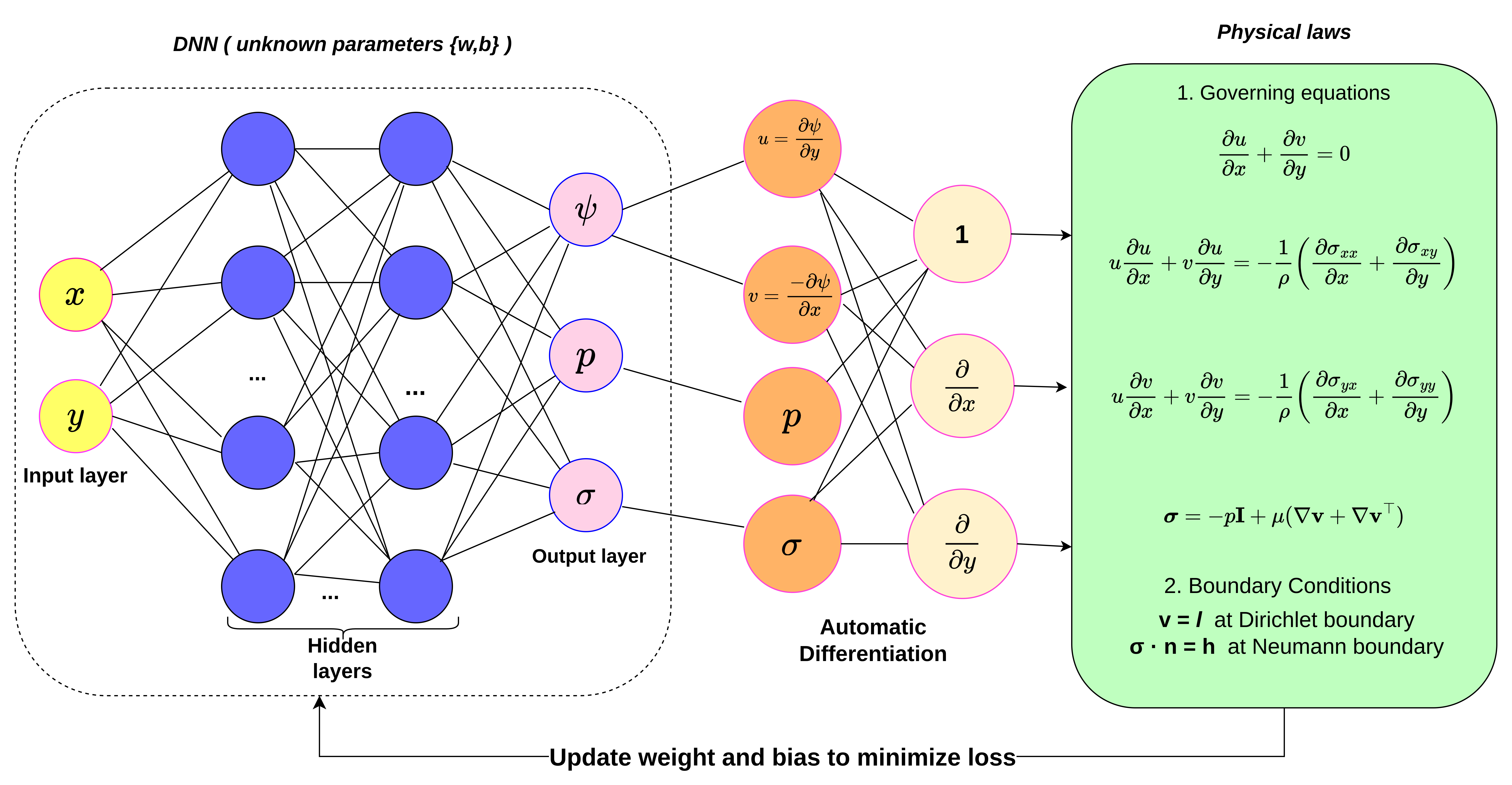
The current study utilizes an unsupervised physics-informed neural network (PINN) that leverages heuristic optimization techniques to solve steady-state incompressible Navier–Stokes and energy equations in wavy channels for varying Reynolds numbers. Further, in asymmetric cases, in-phase and out-phase shifts between upper and lower channel walls are considered to mimic actual physiological structures occurring in many natural and industrial process. Moreover, the energy transfer equation is involved in the flow governing equation to accomplish the mixed convection flow for the fluid volume movement. Overall, the study demonstrates the capability of PINN (a more computationally feasible framework) for solving fluid dynamics and heat transfer problems and elucidating separation and reattachment flow dynamics in complex corrugated geometries.
@article{Roy2025,title={A computational analysis of flow dynamics and heat transfer in a wavy patterned channel using physics-informed neural networks},author={Roy, Aritra and Mukherjee, Ayan and Prasad, Balbir and Nayak, Ameeya Kumar},journal={Physics of Fluids},volume={37},number={4},pages={043610},year={2025},publisher={AIP Publishing},doi={10.1063/5.0264160},url={https://doi.org/10.1063/5.0264160},}
Earth Sci. Inform.
Granite porosity prediction under varied thermal conditions using machine learning models
Rishabh Dwivedi, Balbir Prasad, PK Gautam, and 4 more authors
Earth Science InformaticsAmong the evaluated models, CatBoost and KNN consistently achieved higher R-squared values and lower error metrics, demonstrating their effectiveness in accurately discerning underlying patterns and reliably predicting porosity. , 2025
Porosity estimation at high granite temperatures is essential for numerous purposes, including natural and enhanced geothermal energy production. However, these methods of determining porosity have some disadvantages, such as being labor-intensive, requiring expensive instrumentation, and taking a significant amount of time, particularly during elevated temperature treatments. This study is vital for advancing geothermal energy applications by addressing the limitations of traditional porosity estimation methods. The study introduces innovative predictive machine learning (ML) models and offers insights into practical applications for improving geothermal reservoir management and sustainability.
@article{Dwivedi2025,title={Granite porosity prediction under varied thermal conditions using machine learning models},author={Dwivedi, Rishabh and Prasad, Balbir and Gautam, PK and Garg, Peeyush and Agarwal, Siddhartha and Singh, KH and Singh, TN},journal={Earth Science Informatics},volume={18},number={2},pages={211},year={2025},publisher={Springer},doi={10.1007/s12145-025-01726-y},url={https://doi.org/10.1007/s12145-025-01726-y},}
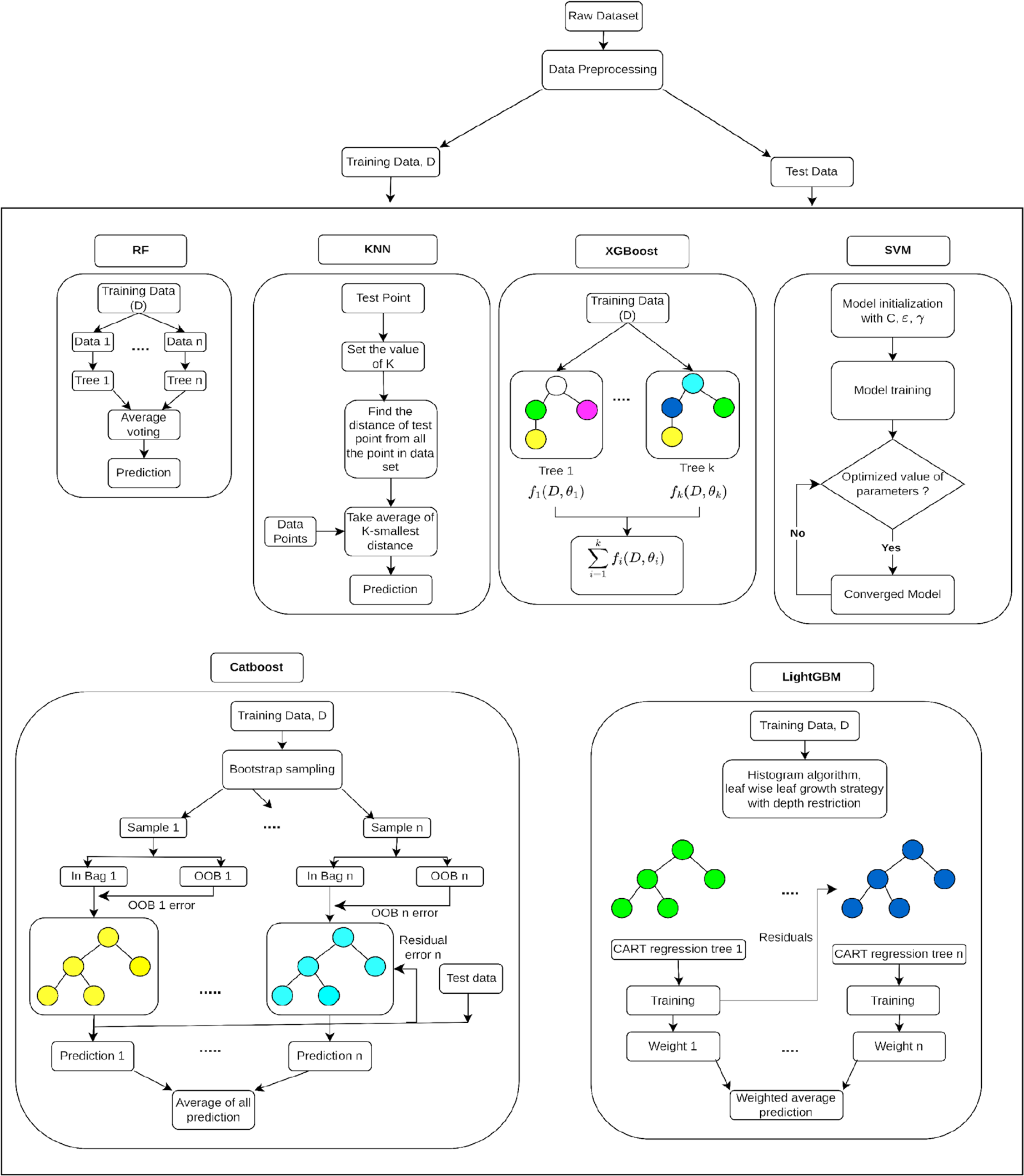 Granite porosity prediction under varied thermal conditions using machine learning modelsEarth Science InformaticsAmong the evaluated models, CatBoost and KNN consistently achieved higher R-squared values and lower error metrics, demonstrating their effectiveness in accurately discerning underlying patterns and reliably predicting porosity. , 2025